

PVC vs Aluminum Window Profile Comparison: Architectural & Engineering Guide
A detailed technical breakdown comparing PVC and thermally broken aluminum window profiles across thermal insulation (Uf values), structural integrity, maintenance, and architectural application scenarios.
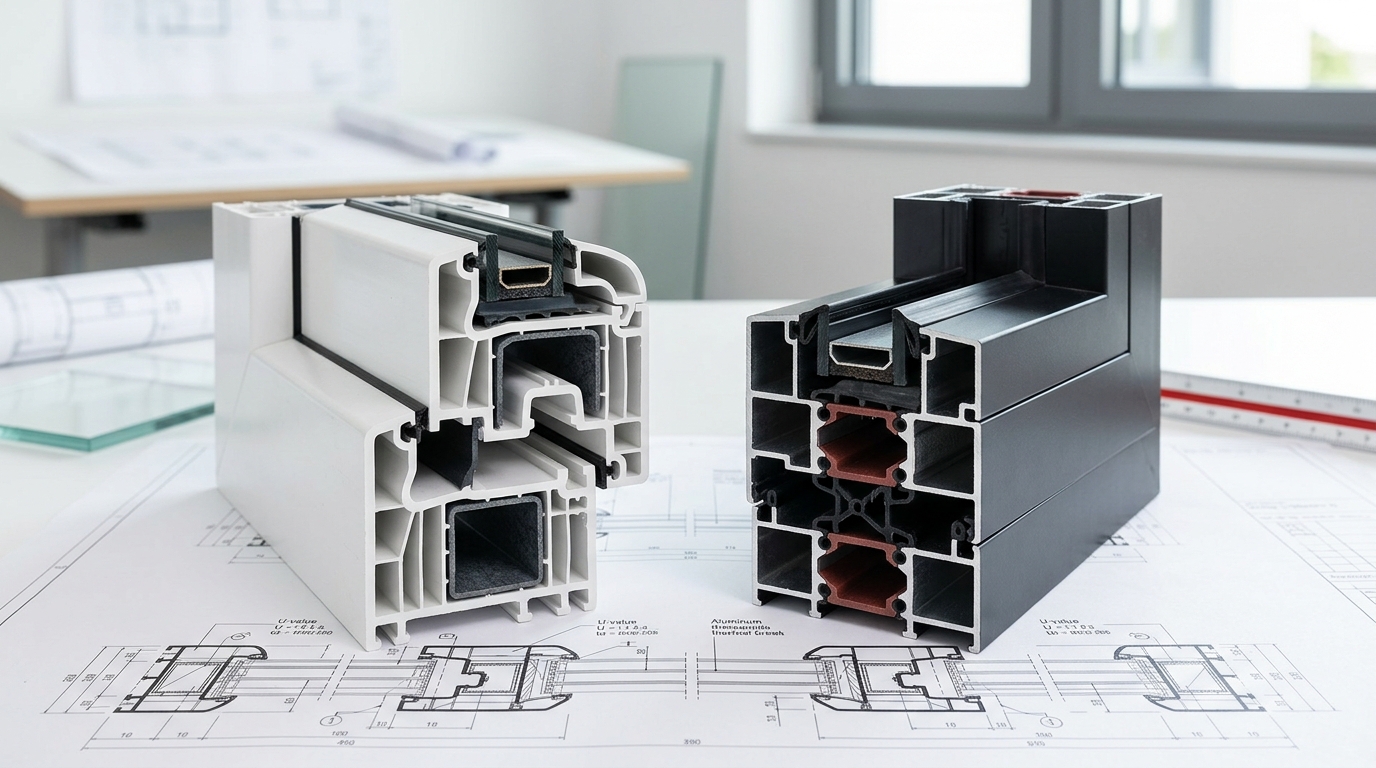
Choosing between unplasticized polyvinyl chloride (PVC) and aluminum window profiles requires a rigorous evaluation of thermal insulation performance, structural loading capacities, aesthetic requirements, and lifecycle costs. While modern multi-chamber PVC profiles deliver exceptional frame thermal transmittance values (Uf) at a cost-effective price point, extruded aluminum systems provide superior structural rigidity necessary for wide-span openings, high wind loads, and minimalist architectural sightlines.
Thermal Insulation Performance: Uf Values and Energy Efficiency
Thermal transmittance (Uf) dictates the efficiency of the window frame. PVC is an inherent thermal insulator with low conductivity (approximately 0.19 W/mK). Advanced multi-chamber designs leverage internal air pockets to inhibit heat transfer, allowing engineered PVC profiles to achieve low Uf values without complex thermal breaks.
Aluminum, as a metal, possesses high thermal conductivity (around 160 W/mK). To meet modern energy efficiency standards, aluminum architectural profiles must utilize structural polyamide thermal breaks that physically separate the outer and inner extruded profiles. When equipped with high-density polyamide isolation strips, thermal break aluminum frames lower heat transfer significantly, though high-end multi-chamber PVC systems generally maintain a slight edge in raw frame insulation efficiency per unit of profile depth.
- PVC Systems: Multi-chamber internal geometry (such as 5 to 7 chambers) naturally restricts convective heat transfer, making systems like the Nova 70 ideal for low-energy and Passive House residential specifications.
- Aluminum Systems: Rely on continuous thermal barriers, specialized gasket arrangements, and insulated glass unit (IGU) integration to match stringent commercial energy codes.
Structural Integrity, Wind Load, and Profile Slimness
Structural rigidity determines maximum allowable sash dimensions, resistance to wind loads, and long-term mechanical stability. Aluminum profile alloys (typically EN AW-6060 or 6063-T6) offer a high strength-to-weight ratio, permitting significantly slimmer sightlines and larger continuous glass surfaces.
In high-rise construction, coastal areas with elevated wind pressures, or commercial facades requiring expansive spans, high-performance architectural systems such as the LR.5100 Opening System provide structural stability that unreinforced PVC cannot achieve. PVC profiles require internal galvanized steel reinforcements to withstand elevated wind loads; however, maximum sash sizes remain inherently limited compared to heavy-duty aluminum designs.
| Technical Parameter | Multi-Chamber PVC Profiles | Thermally Broken Aluminum Profiles |
|---|---|---|
| Material Conductivity | Low (~0.19 W/mK) | High naturally (~160 W/mK), managed via thermal breaks |
| Sightline Width | Moderate to Wide (100–120 mm+) | Ultra-slim options (30–70 mm) |
| Maximum Sash Weight/Span | Standard to High (Steel Reinforced) | Very High (Heavy-duty Architectural Profiles) |
| Corrosion & Salt Resistance | Inert to coastal atmospheric corrosion | Requires Qualicoat anodizing or powder coating |
| Thermal Expansion Coeff. | Higher (~70 x 10^-6 / K) | Lower (~23 x 10^-6 / K) |
Architectural Versatility and Surface Finishes
Surface treatment technology differs fundamentally between the two materials:
PVC Surface Options
PVC profiles utilize co-extruded UV-resistant protective layers or laminated high-performance acrylic foils. Foil technology provides convincing wood-grain textures, architectural grays, and solid colors that resist fading under prolonged solar irradiation.
Aluminum Finishes
Aluminum profiles offer limitless architectural aesthetics through electro-chemically applied anodizing or QUALICOAT-certified electrostatic powder coating. This flexibility allows exact matching with metallic RAL shades, fine-textured matte coatings, and anodized bronze or black finishes often specified in high-end modern facades. Versatile sliding configurations like the LR.3100 Sliding Systems demonstrate how aluminum profiles integrate into contemporary minimalist elevations.
Acoustic Insulation and Environmental Resistance
Acoustic performance depends primarily on the glass configuration and perimeter gasket compression rather than frame material alone. Both multi-chamber PVC and precision-engineered aluminum systems utilize multi-barrier EPDM weatherstripping to prevent acoustic leakage.
From an environmental durability perspective, PVC resists marine environments, aggressive air pollution, and chemical exposures without surface degradation. Modern aluminum systems protected by high-durability architectural coatings perform equally well in coastal zones, provided cut edges and drainage channels are properly treated against filiform corrosion during fabrication.
Selecting the Right Profile System for Project Specifications
Architects and project developers should evaluate frame materials based on building typology, environmental conditions, and design geometry:
- Choose PVC profiles when: Energy efficiency per budget ratio is paramount, heating/cooling energy reduction is the primary goal, or projects involve mid-rise residential developments where standard sash dimensions fit architectural requirements.
- Choose Aluminum profiles when: Architectural design demands floor-to-ceiling glass, ultra-narrow sightlines, large lift-and-slide glass doors, or structural wind load calculations exceed standard PVC limits on upper levels of commercial buildings. explore complete Aluminum Door and Window Systems for detailed engineering dimensions.
Frequently Asked Questions
Do aluminum window profiles expand and contract more than PVC?
No. Rigid PVC exhibits a higher linear thermal expansion coefficient compared to extruded aluminum. PVC frames require adequate expansion gaps during installation to accommodate temperature-induced dimensional changes, whereas aluminum frames offer higher dimensional stability across extreme temperature swings.
Can aluminum windows match the thermal insulation of multi-chamber PVC?
Yes. High-tier thermally broken aluminum profiles utilizing wide polyamide insulating bars, polyolefin foam inserts, and triple-pane glazing can achieve Uw values comparable to top-tier PVC profiles, although at a higher initial material cost.
Which system offers longer service life in heavy commercial applications?
Extruded architectural aluminum systems generally provide higher mechanical wear resistance, making them preferred for high-traffic commercial entryways, curtain walls, and institutional installations.
Engineering and System Specification Support
Selecting between PVC and aluminum window systems requires balancing structural loading calculations, thermal envelope targets, and project budget parameters. For specialized architectural assistance, U-value calculations, or custom fabrication specifications, consult our technical design team through our contact page.