

Engineering High-Performance Fenestration: Why Egelux is the Choice PVC Window Manufacturer
Discover how Egelux delivers engineered Deceuninck PVC window profiles, combining multi-chamber thermal efficiency, wind load resistance, and advanced glazing integration for modern architectural projects.
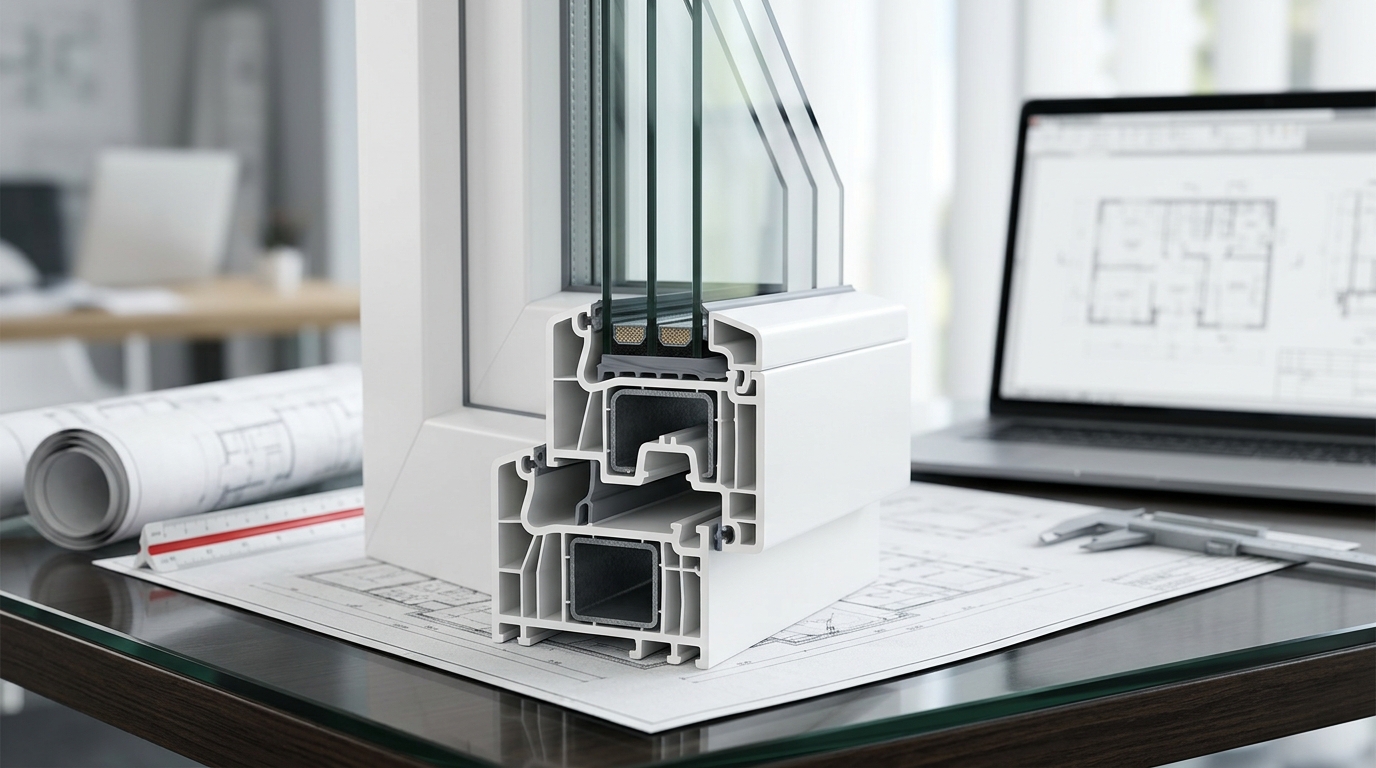
Selecting an authorized egelux pvc window manufacturer ensures access to premium Deceuninck profile technology engineered specifically for demanding structural and thermal standards. Since 2008, Egelux (Ege Oluşum) has integrated advanced extrusion and fabrication methodologies to produce PVC window and door systems capable of achieving exceptionally low frame thermal transmittance values ($U_f$), superior acoustic attenuation, and certified resistance to high wind pressures. Whether specifying fenestration for high-rise commercial structures or energy-efficient residential developments, evaluating profile geometry, gasket engineering, and frame-glass thermal performance remains fundamental to long-term building envelope integrity.
Thermal Dynamics and Multi-Chamber Engineering in PVC Profiles
The thermal efficiency of modern fenestration relies heavily on the internal profile design. Multi-chamber PVC profiles act as insulated thermal barriers, restricting conductive heat transfer across the frame boundary. By creating isolated air chambers within the profile profile walls, convective air currents are neutralized, resulting in lower thermal transmittance.
Advanced systems such as the Prime 80 design series feature multi-chambered depths capable of accommodating triple-glazing units up to 50mm thickness. This structural clearance allows specifiers to integrate Low-E coated glass combinations with argon or krypton gas fills, driving total window thermal transmittance ($U_w$) down to levels suitable for passive housing criteria. For projects requiring balanced structural depth and high thermal retention, the Nova 70 system delivers a robust 70mm profile depth equipped with specialized TPE weather-sealing gaskets that maintain elasticity across extreme temperature fluctuations.
Architectural Performance Comparison: PVC vs. Aluminum Fenestration
Architects and facade engineers frequently evaluate the trade-offs between unplasticized polyvinyl chloride (uPVC) and thermal-break aluminum profiles. While both materials offer long lifecycle performance, their mechanical properties dictate specific application scenarios.
| Technical Parameter | High-Performance PVC Systems | Thermally Broken Aluminum Systems |
|---|---|---|
| Frame Thermal Conductivity ($\lambda$) | Low (~0.14 - 0.17 W/mK) inherent insulator | Higher baseline; requires polyamides |
| Standard Frame Depth Range | 70mm to 80mm multi-chamber profile depth | 60mm to 75mm architectural depth |
| Acoustic Attenuation Capacity | High naturally damped material profile | High with specialized acoustic glazing |
| Aesthetic Flexibility | Laminated foils, textured woodgrains, solid colors | Anodized, powder-coated RAL finishes |
While aluminum systems like the LR.5100 Opening System excel in ultra-wide glass applications where maximal structural rigidity is paramount, engineered uPVC profiles provide superior native thermal insulation without relying heavily on massive thermal break insertions. This inherent insulation reduces condensation risks around interior window perimeters, protecting indoor air quality and interior architectural finishes.
Large-Span Glazing Solutions: Lift-and-Slide (HST) Engineering
Modern architectural layouts prioritize seamless visual connections between indoor and outdoor spaces. Achieving expansive open glass spans without compromising weather resistance requires specialized hardware and robust track mechanics. Lift-and-slide technology solves the weight-to-friction challenge by physically lifting the door sash off the weather seals prior to horizontal movement.
The Vista HST system is engineered to accommodate oversized, heavy glass units while providing smooth single-hand operation. The profile structural core is reinforced with zinc-coated steel sections calculated to withstand substantial wind pressure loads ($C5/B5$ ratings according to EN 12210 standards). Additionally, for standard sliding applications where spatial efficiency is required, the compact Vela sliding system provides multi-point locking mechanisms integrated with continuous perimeter sealing brush assemblies to minimize air infiltration.
Acoustic Attenuation and Sound Isolation Performance
Urban fenestration design requires precise control over sound transmission class (STC) ratings. Exterior noise pollution—ranging from heavy traffic to rainfall impinging on building surfaces—transmits through both the frame matrix and the glass unit. PVC acts as an effective natural acoustic damper due to its viscoelastic material properties.
- Glazing Cavity Optimization: Combining asymmetrical glass pane thicknesses (e.g., 6mm exterior pane with 4mm interior pane) breaks sound wave resonance.
- Laminated Acoustic Interlayers: Integrating PVB (polyvinyl butyral) acoustic interlayers within the glazing package dramatically absorbs mid to high-frequency urban noise.
- Triple Gasket Sealing: Continuous EPDM or TPE center gaskets prevent airborne sound leakage along sash-to-frame contact surfaces.
Deceuninck Manufacturing Standards and Quality Verification
As an authorized manufacturing partner operating from advanced production facilities since 2008, Egelux enforces strict quality control systems across every phase of fabrication. Compound formulations utilize heavy-metal-free calcium-zinc (Ca-Zn) stabilizers, ensuring UV resistance and color stability even under severe solar exposure. Precise corner welding using automated CNC equipment guarantees corner seam structural strength, preventing joint deflection over decades of operational cycling.
Key Technical Questions regarding PVC Profile Specification
What is the typical U-value difference between standard and high-performance PVC profiles?
Standard 60mm 3-chamber profiles generally deliver frame U-values ($U_f$) around 1.5 to 1.7 W/m²K. In contrast, advanced multi-chamber profiles such as 80mm systems achieve $U_f$ values down to 1.0 - 1.1 W/m²K. When paired with high-performance triple glazing ($U_g$ of 0.5 - 0.6 W/m²K), total window $U_w$ ratings often drop below 0.8 W/m²K.
How do multi-chamber PVC profiles withstand high wind loads in high-rise applications?
PVC profiles rely on internal chambers dedicated to thick, galvanized steel reinforcements. Structural engineering software calculates the moment of inertia ($I_x$ and $I_y$ values) required for specific elevation heights and wind zones, ensuring the steel-reinforced profile meets dynamic deflection limits without glass breakage or seal displacement.
Can PVC window profiles be customized for dark exterior finishes without thermal warping?
Yes. Utilizing advanced heat-reflective acrylic foils allows dark exterior colors (such as anthracite gray or black) to reflect solar radiation rather than absorbing heat into the uPVC core. This prevents profile thermal expansion and maintains sash alignment across extreme seasonal shifts.
Technical Consultation and System Integration for Architectural Projects
Specifying high-performance fenestration requires a comprehensive review of structural wind loads, thermal envelope requirements, acoustic criteria, and hardware ergonomics. Integrating engineered PVC systems into modern building envelopes demands precise shop drawings and technical coordination during the preliminary design phase. To request technical datasheets, CAD cross-sections, or project-specific quotation proposals, connect directly with our engineering team through the Egelux contact page.